Is Dairy Queen Ice Cream Real Ice Cream?
DQ has sold the same soft serve since 1940 — and legally, it has never been ice cream. The reason is one number: 5%.
5% butterfat · FDA minimum for “ice cream” is 10% milkfat
5%
Butterfat in Dairy Queen soft serve
10%
Minimum milkfat the FDA requires to call a frozen dessert “ice cream”
1940
The year the first Dairy Queen opened in Joliet, Illinois, selling this soft serve
Unofficial guide. Not affiliated with, endorsed by, or sponsored by International Dairy Queen, Inc.
Prices are estimated US national averages, checked Nov 2026. Dairy Queen publishes no national price list; ~99% stores are franchisee-owned, so prices vary by location.
DQ has sold the same soft serve since 1940 — and legally, it has never been ice cream. The reason is one number: 5%. That is the butterfat content of Dairy Queen soft serve. The US Food and Drug Administration (FDA) says a frozen dessert needs at least 10% milkfat to be called “ice cream”. DQ has half that. So the question “is Dairy Queen ice cream real ice cream?” has a short answer — no, not legally — and a more interesting long answer, because what DQ serves instead is the reason the Blizzard works at all. The short version: DQ soft serve is officially “Artificially Flavored Vanilla Reduced Fat Ice Cream”, real dairy made from milkfat and nonfat milk, using the same formula since the first Dairy Queen opened in Joliet, Illinois, in 1940. The words “ice cream” do not appear in any DQ product name.
The One Number That Decides It: 5% vs 10%
The FDA’s rule is simple and strict. To be labelled “ice cream”, a frozen dessert must contain not less than 10% milkfat and not less than 10% nonfat milk solids, and weigh at least 4.5 pounds per gallon, which limits how much air can be whipped into it.
Dairy Queen’s own website states it plainly: “Technically, our soft serve does not qualify to be called ice cream. To be categorized as ice cream, the minimum butterfat content must be 10 percent, and our soft serve has only 5 percent butterfat content.”
| Legal “ice cream” | DQ soft serve | |
|---|---|---|
| Minimum milkfat | 10% | 5% |
| Official label | Ice cream | Artificially Flavored Vanilla Reduced Fat Ice Cream |
| How it is served | Scooped from a freezer | Dispensed fresh from a machine |
The 5% figure is the recipe, not a shortcut. A soft-serve machine whips air into the mix through tiny holes as it passes to the spout, and a high-butterfat mix would turn to butter inside those holes and clog them. Soft serve is typically made with low butterfat for exactly this reason — most soft serve, from any chain, sits well below the 10% line.
What DQ Actually Serves
When the FDA removed its old “ice milk” category, it let companies label lower-fat frozen desserts as “reduced-fat”, “light” or “low-fat” ice cream. DQ’s soft serve falls into the “reduced-fat” category, and its shake mix would count as “low-fat” — but DQ has never marketed it that way. It calls the product soft serve and leaves it there.
The official disclosure lists the soft serve as “Artificially Flavored Vanilla Reduced Fat Ice Cream”, made from milkfat and nonfat milk, sugar, corn syrup, whey, mono and diglycerides, artificial flavour, guar gum, polysorbate 80, carrageenan and vitamin A palmitate. The “artificially flavored” refers to the vanilla flavouring, not the dairy — and 5% butterfat does not mean the product is 95% fat-free.
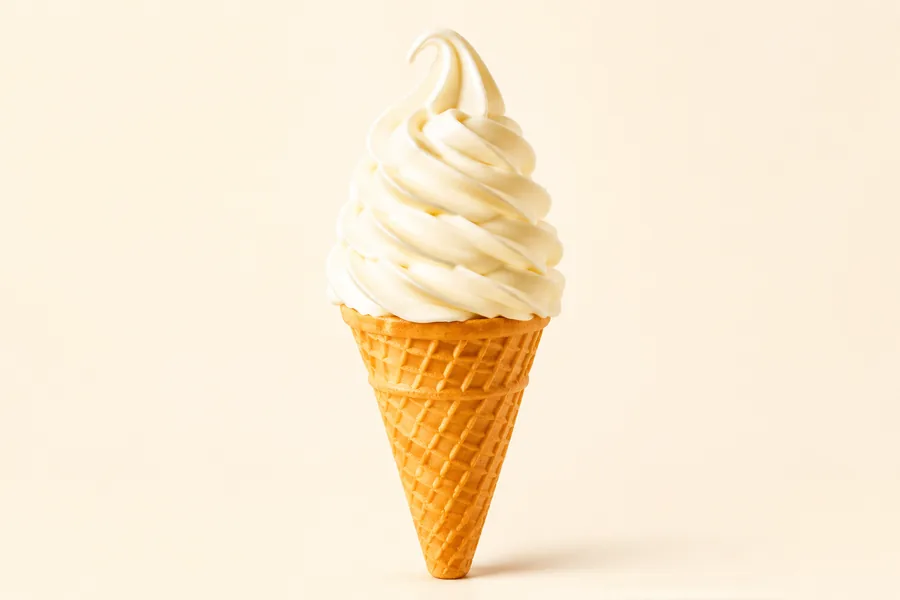
The same base goes into everything on the treat menu. A cone is the soft serve on its own. A sundae is the soft serve with a hot topping. A Blizzard is the soft serve blended with mix-ins until it is thick enough to hold upside down. A shake is the same mix blended thinner.
Why It Still Tastes Like Ice Cream
If the fat is half the legal minimum, why does a DQ cone taste like ice cream and not like frozen milk? Two reasons: air and temperature. Soft serve is served freshly whipped, straight from the machine, so it feels creamy the moment it is dispensed. The whipping folds air into the mix, and that air is part of the texture — light, smooth, and cold enough that the lower fat does not register as thin. Hard ice cream gets its richness from fat. Soft serve gets its richness from being fresh and whipped.
That same whipped, thick texture is why a Blizzard can be flipped upside down without falling out.
None of this makes DQ soft serve a lesser product — it is a different product, built for a machine instead of a freezer.
The Same Recipe Since 1940
Dairy Queen opened its first store in Joliet, Illinois, in 1940, selling soft serve. The Blizzard came much later, in 1985 — and DQ reports that more than 100 million Blizzards were sold in the first year alone. The soft serve inside them was the same 5% formula from 1940, and it still is.
The question usually hides a different worry: has DQ cheapened the recipe over the years? On DQ’s own account, no. The FDA changed its definitions — “ice milk” disappeared, “reduced-fat” appeared — and DQ’s recipe stayed where it was. The menu has never used the words “ice cream” in a product name.
So What Is a Blizzard, Then?
A Blizzard is soft serve plus mix-ins, blended thick. The mix-ins are the flavour — Oreo pieces, Reese’s cups, cookie dough — and the soft serve is the base that carries them. Because the base is only 5% butterfat, it blends smoothly without turning greasy, and because it is whipped, it holds the mix-ins in suspension instead of letting them sink. That is why a Blizzard tastes richer than its fat content suggests — judge it on its mix-ins, not on its milkfat percentage.
| Blizzard size | Typical price | Calories (approx.) |
|---|---|---|
| Mini | $3.49–$3.99 | 350–400 |
| Small | $4.49–$4.99 | 590–640 |
| Medium | $5.29–$5.99 | 790–830 |
| Large | $5.99–$6.49 | 1,000–1,090 |
Confirm at the store — prices vary by location, and each franchise owner sets them.
Does It Matter?
For most people, no. The legal definition of ice cream is a labelling rule, not a quality judgement. It does not say DQ soft serve is bad, fake, or unsafe. It says the product does not meet a fat threshold written into federal regulations.
It matters in exactly two cases. First, if you are counting fat or calories, the 5% figure is genuinely useful: a Mini Blizzard is about 350–400 calories, lighter than a comparable scoop of premium hard ice cream, and the full breakdown is on our nutrition page. Second, in a recipe — a milkshake that needs to stay thick, or a cake that needs a firm base — DQ soft serve behaves differently from hard ice cream. For everyone else: legally no, practically yes.
FAQ
Is Dairy Queen ice cream real ice cream?
No — not legally. The FDA requires at least 10% milkfat for “ice cream”, and DQ soft serve has 5% butterfat. Its official label is “Artificially Flavored Vanilla Reduced Fat Ice Cream”.
Why does DQ only have 5% butterfat?
That is the recipe, unchanged since 1940. A soft-serve machine whips air into the mix, and a high-butterfat mix would turn to butter and clog it. Most soft serve is made with low butterfat for the same reason.
What is DQ soft serve actually called?
Officially “Artificially Flavored Vanilla Reduced Fat Ice Cream”. DQ itself calls it soft serve, and the words “ice cream” do not appear in any DQ product name.
Is soft serve healthier than ice cream?
It is lower in fat, but it is not 95% fat-free, and a Blizzard is still a dessert. A Mini is about 350–400 calories; a Large is about 1,000–1,090.
Is a Blizzard ice cream?
A Blizzard is soft serve blended with mix-ins. The base is the same 5% soft serve, so it is not ice cream by the legal definition either — but the mix-ins are what you are tasting.
Has Dairy Queen changed its soft serve recipe?
No, on DQ’s own account. The formula has stayed the same since 1940, even as the FDA changed its definitions around it.
Do McDonald’s and Wendy’s have the same issue?
Yes. McDonald’s cones and the Wendy’s Frosty are also soft serve, not legally ice cream, for the same reason.
Last updated: Nov 2026. Unofficial guide. Not affiliated with, endorsed by, or sponsored by International Dairy Queen, Inc. See also: Dairy Queen Nutrition & Calories, Dairy Queen Blizzard Menu, Dairy Queen Menu FAQ.